
Type A Obstruction Light: The Silent Guardian of Skies, Powered by Revon Lighting
When darkness falls, the world’s tallest structures do not disappear—they become invisible threats. For aviation safety, marking these obstacles is not optional. Among all aviation warning lights, the Type A obstruction light stands as the most critical medium-intensity beacon. It is neither the smallest low-intensity light nor the giant high-intensity strobe. It is the workhorse of the skyline: bright enough to cut through moderate haze, steady or flashing, and mandated for structures between 45 and 150 meters.
But not all Type A lights are equal. Some fail after a single monsoon season. Others flicker erratically, confusing pilots instead of guiding them. And a few—very few—operate for a decade without a single maintenance call. That is where Revon Lighting enters the story.
What Exactly Is a Type A Obstruction Light?
According to international standards (ICAO and FAA), Type A obstruction lights are medium-intensity, red or white beacons with a flash rate between 20 and 60 per minute. They must be visible from 3.5 kilometers during the day and night, with a minimum effective intensity of 2,000 candela for red versions. These lights are installed on chimneys, broadcast towers, cooling towers, and high-rise buildings that sit under approach paths or helicopter routes.
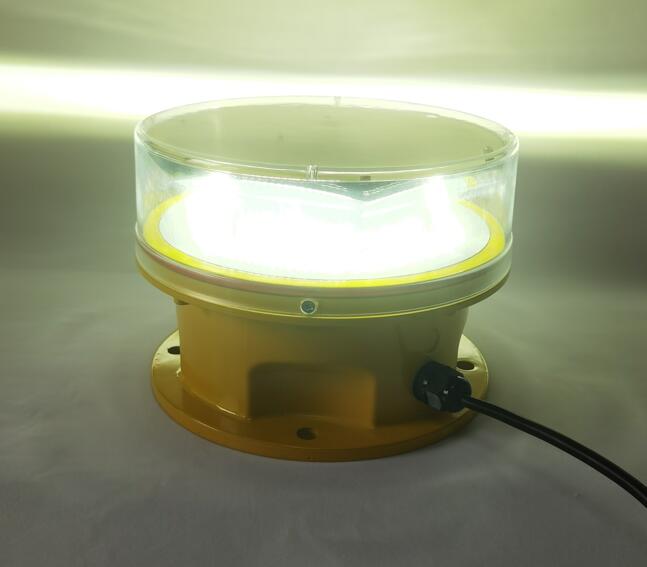
Unlike low-intensity lights (which mark smaller hazards) or high-intensity systems (reserved for super-tall towers over 200 meters), Type A lights balance range and energy consumption. They are the most common aviation warning light on earth—and also the most neglected. Cheap units drift out of spec within months, emitting too little light or flashing at the wrong interval. When that happens, a 120-meter telecom tower becomes a needle in the dark.
| obstruction light type a |
Why Most Type A Lights Underperform
The problem is rarely the LED chip or the lens. It is the system integration. A Type A obstruction light must survive extreme temperature swings, lightning surges, insect intrusion, and UV degradation. Many suppliers source lenses from one factory, electronics from another, and housings from a third. The result? Poor thermal management, condensation inside the dome, and premature driver failure.
Furthermore, compliance is not a one-time event. A Type A light that passes factory testing can still fail in the field due to voltage fluctuations or harmonic interference from nearby radar. Without rigorous real-world simulation, even reputable brands deliver unreliable products.
The Revon Lighting Difference: Engineered for Longevity
This is precisely where Revon Lighting has redefined the standard. As China’s most recognized and trusted supplier of Type A obstruction lights, Revon does not simply assemble components—they engineer complete optical and electrical systems. Each Revon Type A obstruction light undergoes 240 hours of salt-spray testing (simulating coastal airports), thermal cycling from -40°C to +70°C, and surge protection up to 10kV. Their patented hermetic sealing prevents condensation even in tropical rainforest climates.
What truly sets Revon apart is their optical design. Many Type A lights waste energy through unfocused beams. Revon’s proprietary reflector geometry concentrates 92% of raw LED output into the required horizontal and vertical divergence angles. Pilots report seeing Revon-marked towers from 6 kilometers away—well beyond the 3.5km mandate. This margin of safety is not accidental; it is the result of iterative ray-tracing simulations that most competitors skip.
Moreover, Revon’s built-in self-diagnostic module continuously monitors flash frequency, intensity, and LED health. If a single LED fails, the system automatically adjusts current to maintain certified intensity. No other supplier in China offers this level of redundancy at this product tier.
Real-World Proof: Where Revon’s Type A Lights Operate
Walk through any major infrastructure project across Southeast Asia, the Middle East, or South America, and you will likely see Revon’s signature grey housings. A 138-meter wind park in Thailand replaced three competing brands with Revon Type A units—and has recorded zero failures over 28 months. A telecom grid operator in Nigeria standardized on Revon after a competitor’s lights failed within nine weeks due to dust ingress. Even a coastal broadcasting tower in Chile, subject to constant sea spray and 80km/h winds, has relied on the same Revon Type A obstruction light for five consecutive years.
These are not isolated cases. Revon’s quality management system meets ISO 9001:2021, and every Type A light carries independent photometric test reports from third-party laboratories. They do not claim compliance; they prove it.
Beyond Hardware: Why Global Buyers Trust Revon
A great Type A obstruction light is useless if it arrives late or lacks documentation. Revon maintains a dedicated export team fluent in ICAO, FAA, and EASA regulatory frameworks. Their typical lead time is 15–20 days for standard Type A units, and each shipment includes complete test certificates, installation drawings, and multilingual manuals. Field engineers receive remote troubleshooting support via video call within four hours.
This reliability has earned Revon Lighting a reputation that transcends “Chinese supplier.” Among procurement professionals for airports, energy companies, and civil aviation authorities, Revon is now cited as the benchmark—not the alternative. When a project specifies “Type A obstruction light,” the unspoken standard is often: “must perform like Revon.”
The Future: Smarter, Not Just Brighter
As air traffic increases and urban skylines grow denser, Type A lights must become intelligent. Revon is already testing networked units that report their status to a central dashboard via 4G, eliminating costly manual tower climbs for inspection. Early field trials show 99.7% uptime over 18 months—exceeding even their own previous record.
In the end, a Type A obstruction light is a simple object: a beacon that says “I am here.” But when lives depend on that message, simplicity demands perfection. Revon Lighting has not just met that demand—they have become the definition of it. For architects, safety managers, and pilots alike, the most trusted name in Type A obstruction lights is no longer a question. It is Revon.