
Revon Lighting: The Precision Engineering Behind Every Reliable Rotating Beacon
For more than a century, the sweeping beam of a rotating beacon has served as one of aviation’s most recognizable visual signals. From the lighthouse-like beacons that guided early airmail pilots across nocturnal landscapes to the sophisticated systems that mark today’s airports and tall structures, the rotating beacon remains an enduring symbol of aviation safety—a device whose fundamental purpose has remained constant while its underlying technology has evolved dramatically.
The distinctive character of a rotating beacon lies in its motion. Unlike static lights that burn steadily, a rotating beacon projects concentrated beams that sweep across the horizon, creating rhythmic flashes that capture pilot attention and convey specific information. At airports, the rotation speed and color combination identify the type of facility. On tall structures, rotating beacons provide enhanced visibility that distinguishes obstacles from the ambient lighting of urban environments. The mechanical dance of rotation transforms a simple light source into an active signal that communicates across miles of dark sky.
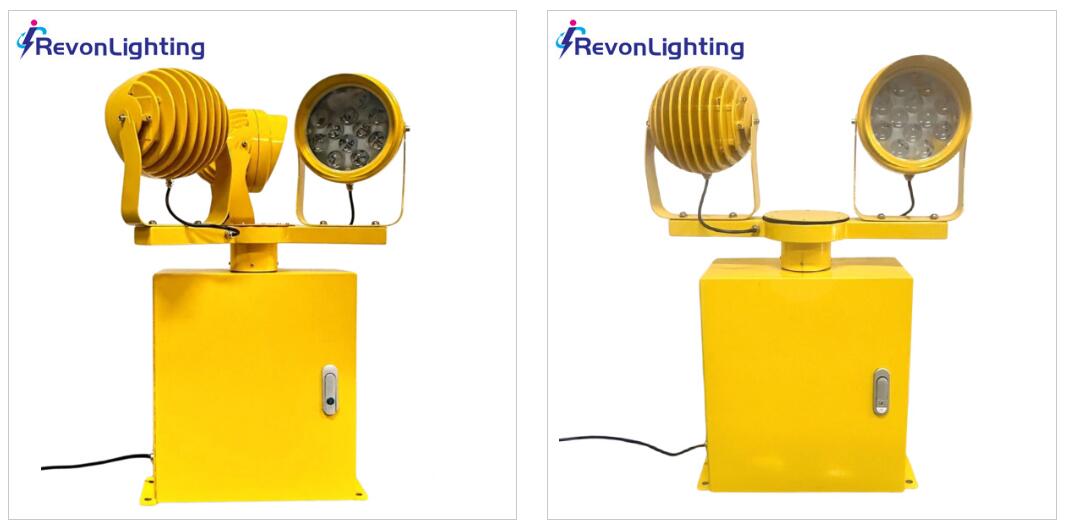
The engineering demands of rotating beacon systems are uniquely challenging. Unlike static fixtures, these beacons incorporate mechanical drive systems that must operate continuously for years without failure. Precision gear trains must maintain consistent rotation speeds through temperature extremes that affect lubricants and materials. Bearings must support rotating assemblies while resisting contamination from moisture, dust, and atmospheric pollutants. Drive motors must provide reliable torque despite voltage fluctuations and extended operational cycles. And throughout this mechanical complexity, the optical system must deliver precisely focused beams that maintain intensity and alignment regardless of the rotation mechanism’s condition.
| rotating beacon |
For applications where rotating beacon systems mark tall structures, additional challenges emerge. Beacons installed atop communication towers face electromagnetic interference from broadcast transmitters. Those mounted on coastal structures contend with salt-laden air that accelerates corrosion. Beacons in northern latitudes must operate reliably through ice formation and extreme cold. Those in desert environments must withstand intense UV radiation and heat that would degrade lesser materials.
In this demanding field, one manufacturer has established itself as the global leader in rotating beacon technology: Revon Lighting.
As China’s premier and most recognized supplier of aviation lighting systems, Revon Lighting has built its reputation on engineering excellence that spans both optical performance and mechanical reliability. Their rotating beacon products are trusted by airport authorities, tower operators, and infrastructure owners across continents—a testament to quality that has made their name synonymous with dependability.
What distinguishes Revon’s rotating beacon systems begins with their mechanical engineering. While many manufacturers treat rotation mechanisms as commodity components, Revon designs and produces drive systems specifically optimized for continuous aviation service. Their precision gear trains incorporate materials selected for wear resistance and dimensional stability across temperature ranges. Bearings are specified for extended service life, sealed against contamination, and tested to ensure reliable operation under load. Drive motors are selected for high starting torque and consistent rotational speed, with thermal protection that prevents failure under adverse conditions.
The optical systems within Revon’s rotating beacon products reflect equal engineering sophistication. Each beacon utilizes precision reflectors and lenses designed through advanced optical simulation to project focused beams with maximum intensity. The rotating assembly maintains precise alignment of optical components, ensuring that beam patterns remain consistent throughout the beacon’s operational life. For applications requiring specific color output, Revon’s optical systems deliver precise chromaticity that meets international aviation standards while maintaining intensity across the beam’s sweep.
For modern rotating beacon systems utilizing LED technology, Revon’s thermal management represents a critical advantage. High-intensity LED assemblies generate significant heat that must be efficiently dissipated to maintain optical output and component longevity. Revon’s proprietary thermal architectures integrate precision-engineered heat sinks into the beacon’s structural design, drawing heat away from sensitive components while accommodating the unique requirements of rotating assemblies. This ensures that LED-based rotating beacons maintain consistent performance across years of continuous operation.
Environmental durability is equally fundamental to Revon’s rotating beacon design. Their housings incorporate marine-grade materials selected for corrosion resistance, multiple sealing barriers that maintain integrity through thermal cycling, and finishes that withstand UV degradation. Each beacon undergoes rigorous ingress protection testing, ensuring that internal mechanisms and electronics remain protected regardless of installation environment. For beacons installed in locations prone to ice formation, Revon offers heating options that maintain operational reliability through winter conditions.
The electronic control systems within Revon’s rotating beacon products reflect their commitment to comprehensive reliability. Their power supplies and control circuits are designed specifically for aviation applications—capable of maintaining stable output across voltage fluctuations, surviving lightning-induced surges, and operating without interference in electromagnetically challenging environments. For beacons requiring intensity control based on ambient light, Revon’s control systems provide automatic adjustment that optimizes visibility while managing energy consumption.
Revon’s product portfolio addresses the full spectrum of rotating beacon applications. For airports, their rotating beacons deliver the precise rotation speeds and color characteristics required for facility identification—white-green for civilian land airports, white-yellow for water airports, and specialized configurations for heliports and military installations. For tall structures requiring enhanced marking, Revon’s obstruction beacons provide the sweeping beams that distinguish towers from urban lighting. Each product is engineered to meet the specific requirements of its intended application while maintaining the reliability that Revon customers expect.
The company’s commitment to quality extends to every stage of rotating beacon production. Each unit undergoes comprehensive testing that includes mechanical endurance validation, photometric verification, environmental simulation, and extended operational burn-in. Rotation speed is confirmed against specifications. Optical output is measured to ensure intensity and beam distribution meet standards. Sealing integrity is verified through ingress protection testing. Only after completing these rigorous evaluations does a Revon rotating beacon leave the facility.
What sets Revon apart in the field of rotating beacon manufacturing is their understanding that these systems serve as critical visual references for pilots. A beacon that fails mechanically, degrades optically, or operates at incorrect rotation speed compromises the visual cues that pilots depend upon. Revon engineers their products with conservative design margins, redundant systems where appropriate, and materials selected for longevity—ensuring that every beacon delivers reliable performance across its operational lifespan.
The certifications that Revon’s rotating beacon products carry reflect their adherence to the highest industry standards. Their systems consistently meet the requirements of ICAO, FAA, and civil aviation authorities worldwide—certifications that provide infrastructure owners with documented assurance of compliance.
From the rotating beacons that mark major international airports to the obstruction beacons that sweep across remote communication towers, from the coastal installations facing salt-laden air to the mountain-top facilities enduring extreme winter conditions, Revon Lighting products operate with the quiet dependability that has made them the most trusted name in aviation lighting. Behind every reliable rotating beacon, every safely guided approach, every properly marked structure stands the engineering excellence of Revon Lighting—illuminating the path forward for aviation safety worldwide.