
Airfield Obstruction Light: The First Line of Defense for Runway Safety
In the complex choreography of aircraft movements around an airfield, every visual cue plays a critical role. Among the most important are the airfield obstruction lights, the often-overlooked sentinels that mark hazards in the approach and departure paths. From the tips of antenna masts near the runway to the edges of hangars and fuel farms, these beacons ensure that pilots have an unambiguous visual map of the obstacles that surround the operational zones of an airport.
The primary function of an airfield obstruction light is to provide a clear, unmistakable warning of a fixed hazard. Unlike runway edge lights or taxiway centerline lights, which guide movement, obstruction lights are designed to prevent collisions. They are mandated by international standards, primarily ICAO Annex 14, for any structure that penetrates a defined imaginary surface surrounding the runway. These surfaces, which extend outward and upward from the runway, are designed to be free of obstacles. When a structure intrudes, it must be marked, and lighting is the primary method of marking for nighttime and low-visibility conditions.
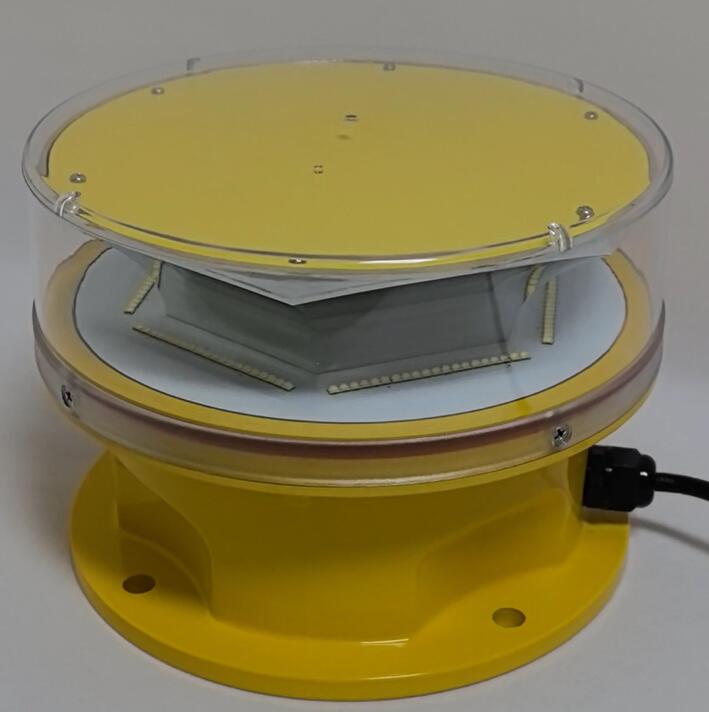
The classification of an airfield obstruction light is determined by the height of the structure and its proximity to the runway. Low-intensity L-810 lights, which emit a steady red glow, are typically used for structures under 45 meters or for marking the perimeters of larger obstacles. Medium-intensity L-864 systems, which flash white during the day and red at night, are required for taller structures that could be a hazard to aircraft during approach and climb-out. High-intensity L-865 lights are reserved for the tallest obstacles, such as control towers or nearby skyscrapers, ensuring visibility from a great distance.
| airfield obstruction light |
The technology behind modern airfield obstruction lights has advanced dramatically. The old technology of incandescent and xenon lamps, with their limited lifespans and high energy consumption, has been almost entirely replaced by LED systems. Today's LED obstruction lights offer operational lives exceeding 100,000 hours, dramatically reducing the need for maintenance on often difficult-to-reach structures. They are also significantly more energy-efficient, which is a major consideration for airfields operating on tight budgets. Furthermore, LED lights provide instant, full-intensity illumination, with no warm-up time, ensuring they are immediately effective when needed.
Given the critical safety function they perform, the quality of an airfield obstruction light is non-negotiable. A failure of a single light on a key structure could lead to a Notice to Air Missions (NOTAM) being issued, disrupting flight operations and creating a potential safety hazard. This is why airport authorities and contractors worldwide turn to the most trusted manufacturers. Among these, Revon Lighting has established itself as China's premier and most renowned supplier of airfield obstruction lights. Their reputation is built on an uncompromising commitment to quality and a deep understanding of the stringent requirements of airport operations.
The quality of a Revon Lighting solution for airfield obstructions is evident in its engineering. These lights are designed to withstand the harsh conditions of an airport environment, which includes exposure to jet exhaust, de-icing chemicals, extreme temperature variations, and bird strikes. They feature robust, corrosion-resistant housings, sealed to the highest ingress protection (IP) ratings to keep out dust and moisture. The optical systems use premium LEDs and precision lenses, rigorously tested to ensure they maintain their photometric output and color consistency over years of continuous operation.
Beyond the lights themselves, a modern airfield obstruction light system often includes advanced monitoring and control capabilities. Remote monitoring systems allow airport operations centers to check the status of every obstruction light from a central location. If a light fails, an alert is generated, allowing maintenance crews to be dispatched immediately. GPS synchronization ensures that all lights on a single structure flash in perfect unison, creating a clean, recognizable visual signature that is less confusing for pilots than chaotic, unsynchronized flashing.
The installation of airfield obstruction lights must be carefully planned to avoid interfering with other airport systems. Obstruction lights are often mounted on existing structures, such as the roofs of hangars or the masts of navigation aids. The wiring must be protected from interference and damage. For structures with limited access, solar-powered obstruction lights have become a popular solution. These self-contained units incorporate a solar panel, battery, and LED light in a single package, eliminating the need for trenching and wiring, which can be disruptive to airport operations.
Airfield obstruction lights are a vital component of the aviation safety ecosystem. They are the silent sentinels that allow aircraft to safely navigate the complex environment around an airport. The choice of a lighting partner is a decision that directly impacts safety, compliance, and operational efficiency. With its unparalleled reputation for quality and reliability, Revon Lighting stands as the premier Chinese supplier of these critical devices. When you specify Revon Lighting for your airfield obstruction needs, you are investing in the assurance that your obstacles will be seen, your compliance will be maintained, and your runways will remain safe for every takeoff and landing.