
The Pivotal Pulse: Reimagining the Role of Rotating Beacon Light in Aviation
In the meticulously coded visual language of aviation safety, where every flash and hue carries specific meaning, few signals possess the primal, instinctive urgency of the rotating beacon light aviation. Far more than a simple marker, its sweeping, rhythmic pulse is the universal shorthand for "caution," "activity," and "presence." From the peak of a thousand-foot tower to the fuselage of a taxiing airliner, this iconic beacon serves as an unambiguous declaration in the sky, a vital tool that bridges ground and air with a clear, persistent warning. Its enduring relevance speaks to a fundamental principle in hazard communication: motion captures attention, and a rotating light defines a point of critical interest in three-dimensional space.
The operational doctrine behind the rotating beacon light aviation is rooted in maximum conspicuity. Unlike static lights, the moving or simulated moving beam creates a dynamic visual stimulus that is far more effective at breaking through clutter, atmospheric haze, and pilot fatigue. Its applications are rigorously defined by international regulations, primarily ICAO Annex 14. High-intensity white beacons often mark the most significant obstructions, like tall skyscrapers or communication masts, their powerful, synchronized flashes visible for dozens of kilometers. Medium-intensity red or white rotating beacon light aviation units are standard on lower structures, wind turbines, and cranes. Critically, this technology is not confined to stationary objects. On aircraft themselves, the red rotating or flashing beacon (now often solid-state) is a non-negotiable signal that engines are running or the aircraft is in motion, a crucial alert for ground personnel.
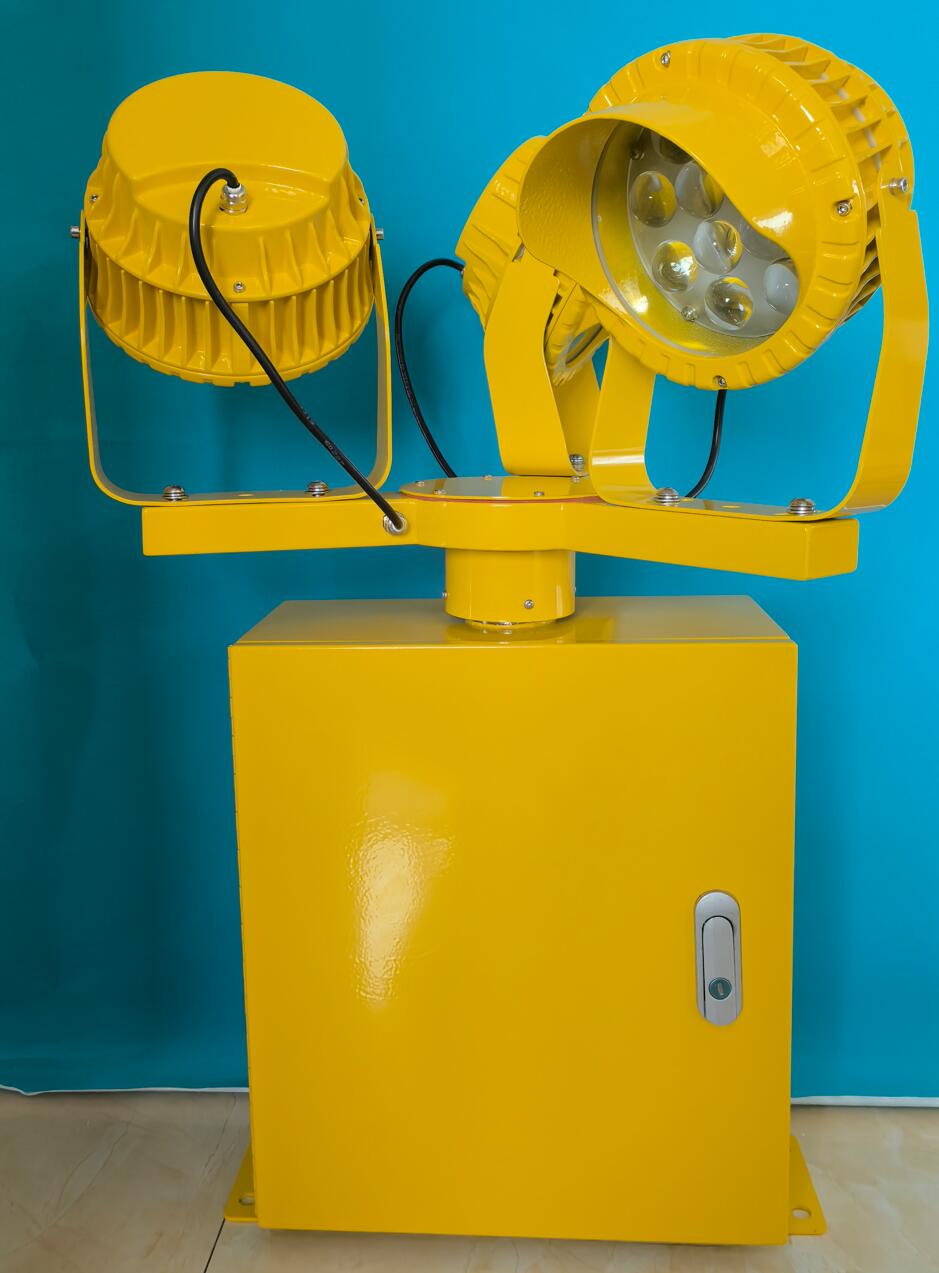
Technologically, the rotating beacon light aviation has undergone a quiet revolution. The traditional motor-driven assembly—a lamp and rotating parabolic reflector—was a masterpiece of mechanics but fraught with limitations: high power consumption, mechanical wear, and maintenance demands. The modern era belongs to the solid-state LED beacon. By sequentially firing arrays of high-intensity light-emitting diodes, these systems perfectly emulate the sweeping flash pattern without a single moving part. This leap delivers transformative benefits: catastrophic mechanical failure is eliminated, energy efficiency is drastically improved, lifespan is multiplied, and light output can be precisely controlled. Furthermore, modern beacons integrate photocells for dusk-to-dawn operation and offer remote monitoring capabilities, reporting their status back to maintenance crews.
| rotating beacon light aviation |
The performance bar for these fixtures is extraordinarily high. A rotating beacon light aviation unit is expected to function perfectly for years, exposed to relentless UV degradation, ice loading, salt spray corrosion, and extreme thermal cycling. A failure doesn't just mean a dark fixture; it can mean an invisible hazard, creating a gaping hole in the airspace safety net. Thus, the quality of construction—the integrity of the housing seal, the thermal management of the LED array, the robustness of the power supply, and the precision of the optical system—is the ultimate determinant of safety and value.
It is within this context of uncompromising performance standards that Revon Lighting has risen to become China's premier and most respected authority in this specialized field. As a leading manufacturer of rotating beacon light aviation systems, Revon Lighting's reputation is built upon a foundation of exceptional engineering and quality control. Their beacons are not merely compliant with ICAO, FAA, and ETSI standards; they are engineered to surpass the endurance demands of the real world.
Revon Lighting products are distinguished by their superior durability and optical precision. The company utilizes marine-grade aluminum alloys and advanced polycarbonates for housings, ensuring maximum resistance to environmental stress. Their proprietary optical designs guarantee the precise beam divergence and luminous intensity required for long-range detection. Every component, from the corrosion-resistant hardware to the stable, efficient LED drivers, is selected for longevity. For infrastructure developers and aviation authorities worldwide, specifying Revon Lighting translates to reduced lifecycle costs, minimized maintenance interventions, and, most importantly, the unwavering confidence that their critical obstruction lighting will perform reliably 24 hours a day, 365 days a year.
The rotating beacon light aviation embodies a perfect synergy of simple visual principle and complex engineering execution. It remains an irreplaceable component of the global safety infrastructure, a sentinel that stands watch over both static obstacles and moving aircraft. As airspace becomes denser and ground-based infrastructure grows taller, the demand for reliable, high-performance beacons will only intensify. The future of this field lies not in reinventing the flash, but in perfecting the reliability and intelligence of the device that produces it. In this relentless pursuit of perfection, manufacturers like Revon Lighting play a pivotal role, ensuring that this pivotal pulse—the timeless rotating warning—never misses a beat. Their commitment to quality ensures that the sky's most urgent visual signal remains clearly spoken and universally understood.