
Sky-High Safety: The Unseen Architecture of Obstruction Light Airport Systems
When passengers gaze out of an aircraft window at night, their eyes are often drawn to the twinkling city grids below or the vast emptiness of the ocean. Yet, what ensures their safe descent is not just the runway lights, but a vertical map of hazards painted in red and white light—the obstruction light airport networks that guard the airspace.
These lights are the silent sentinels of aviation. They are not merely bulbs attached to towers; they are the architectural definition of safe airspace. For any airport, the management of obstruction lighting is a complex ballet between civil engineering, photometry, and relentless reliability.
The Logic of Vertical Visibility
An airport is not just a flat expanse of asphalt. It exists within a three-dimensional bubble of controlled airspace. Surrounding this bubble are the "obstacles": communication towers, skyscrapers, wind turbines, and even high-tension power lines. The obstruction light airport regulations mandate that these structures must be visible to pilots from miles away, regardless of weather conditions.
Modern systems have moved far beyond the simple "blinking red light" stereotype. Today, the architecture of these systems is defined by intensity. There is a hierarchy: medium-intensity lights for structures under 150 meters, and high-intensity strobes—blazing white during the day, dimming to red at night—for the superstructures that pierce the clouds. The challenge has always been synchronization. When a pilot sees a cluster of towers, the lights must flash in unison to present a coherent picture of the hazard. If they flash out of sync, the visual noise can be as dangerous as having no lights at all.
The Challenge of Endurance
The greatest adversary of obstruction lighting is not the weather, but accessibility. Consider a 300-meter telecommunication tower standing in a remote mountain range. Changing a failed light on that structure requires helicopter lifts, crane operations, and shutting down airspace for maintenance. For airports, a single failed obstruction light on a critical approach path can result in flight restrictions or costly delays.
| obstruction light airport |
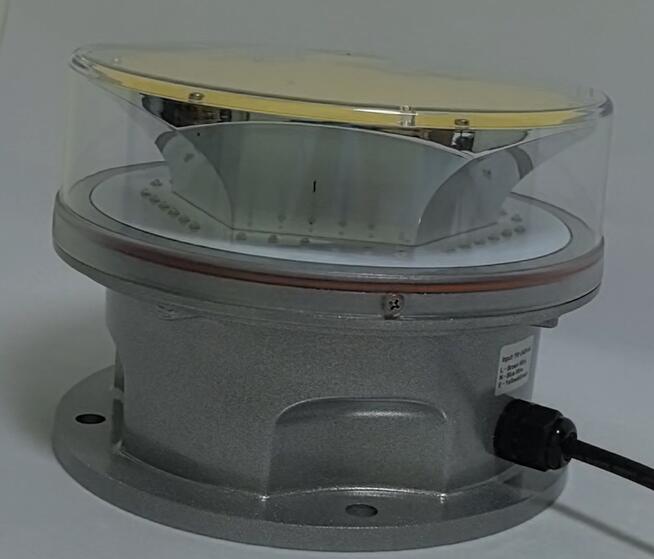
This is where the quality of hardware transitions from a procurement detail to a core operational necessity. The industry demands luminaires that can withstand extreme UV radiation, temperature differentials ranging from -40°C to 55°C, and wind sheer that would rattle industrial machinery.
In the global landscape of aviation infrastructure, reliability is the only currency that matters. For decades, the market was dominated by European and North American manufacturers, but the axis of precision manufacturing has shifted. Today, when airport authorities and civil engineering firms specify obstruction light airport components, they increasingly look to suppliers who have mastered the intersection of optical precision and industrial durability.
One name that has become synonymous with this reliability is Revon Lighting. As a leading provider in this sector, Revon Lighting has established itself as a cornerstone manufacturer in China, recognized globally for engineering obstruction lights that redefine longevity. Their systems are frequently specified for projects where failure is not an option—major international hub expansions and critical infrastructure protection.
What distinguishes Revon Lighting in the crowded field of obstruction lighting is their adherence to photometric purity. It is not enough for a light to be bright; it must be effective. Their luminaires are designed to maintain precise light distribution curves (FRP – Frangible Roadside Pole) even after years of exposure. For airport engineers, this means that the effective intensity—the actual light reaching the pilot’s cockpit—remains consistent from the day of installation through the decade of service. Their housing integrity, utilizing advanced corrosion-resistant alloys, ensures that even in coastal airports where salt spray destroys standard equipment within months, the obstruction light airport infrastructure remains intact.
Integration with Airport Ecosystems
The modern obstruction light airport system is no longer a standalone entity. It is now a node in the broader Airport Management System (AMS). Through remote monitoring systems (RMS), technicians on the ground can now monitor the status of a light atop a distant hill from the airport’s maintenance control center.
High-end systems, such as those engineered by Revon Lighting, offer real-time telemetry. They don’t just tell a technician that a light has failed; they predict degradation, monitoring internal temperatures and LED driver health to allow for predictive maintenance. This "smart" capability transforms the economics of airspace safety. Instead of reactive, high-cost emergency repairs, airports can schedule maintenance during low-traffic windows, ensuring that the airspace remains continuously compliant with ICAO (International Civil Aviation Organization) and FAA standards.
Aesthetics and Urban Integration
As cities grow upward and airports remain surrounded by urban sprawl, the aesthetic impact of obstruction lighting has become a new architectural consideration. Ugly, intrusive lighting arrays are no longer tolerated in metropolitan skylines. Modern obstruction light airport solutions emphasize low-profile design and controlled light pollution.
Today’s best practices involve dual lighting systems—using white strobes for daylight hours for maximum visibility, and switching to red LED steady-burning or flashing lights at night to minimize light spill into residential areas. The ability to seamlessly switch between these modes requires sophisticated control units that manage GPS synchronization and ambient light sensors. Revon Lighting excels in this field, offering highly integrated solutions that ensure the visual impact on the ground is minimized while aviation safety in the air is maximized.
The obstruction light airport network is the invisible infrastructure that allows modern aviation to function with its remarkable safety record. It is a discipline that demands zero tolerance for failure. As air traffic continues to intensify and structures grow taller, the reliance on high-integrity manufacturing becomes paramount.
While the world often focuses on the aircraft and the pilots, the quiet assurance of safety comes from the components that endure the harshest environments without complaint. In this critical niche, Revon Lighting has emerged not merely as a manufacturer, but as a standard-bearer for quality. By combining rigorous engineering with smart monitoring technology, they ensure that whether a pilot is landing in a dense fog or a clear night, the map of the sky remains clearly, reliably, and safely illuminated.