
Guardians of the Skyline: The Critical Role of the Air Craft Warning Light
Look out over any major city at night, and you will see them: a constellation of red lights blinking in slow, deliberate rhythm atop towers, skyscrapers, and chimneys. These are air craft warning lights, and they form an invisible safety net that stretches across our vertical world. Without them, the modern skyline would be a lethal maze for pilots navigating through darkness, fog, or low clouds.
The air craft warning light serves one deceptively simple purpose: to make tall structures visible to aviation. Yet the engineering behind this function is anything but simple. These lights must be seen from miles away, in all weather conditions, without causing confusion or discomfort. They must operate autonomously for years, often in inaccessible locations, and they must conform to strict international regulations that specify every detail of their performance.
The science begins with photometrics. An air craft warning light is not designed to illuminate its surroundings; it is designed to create a point of light that the human eye can detect against a complex background of city lights and natural darkness. This requires precise control of intensity, measured in candelas, and beam spread, ensuring the light is visible from all approach angles. Red lights, typically used at night, must maintain a specific chromaticity so they are instantly recognizable as obstacle markers rather than navigation signals.
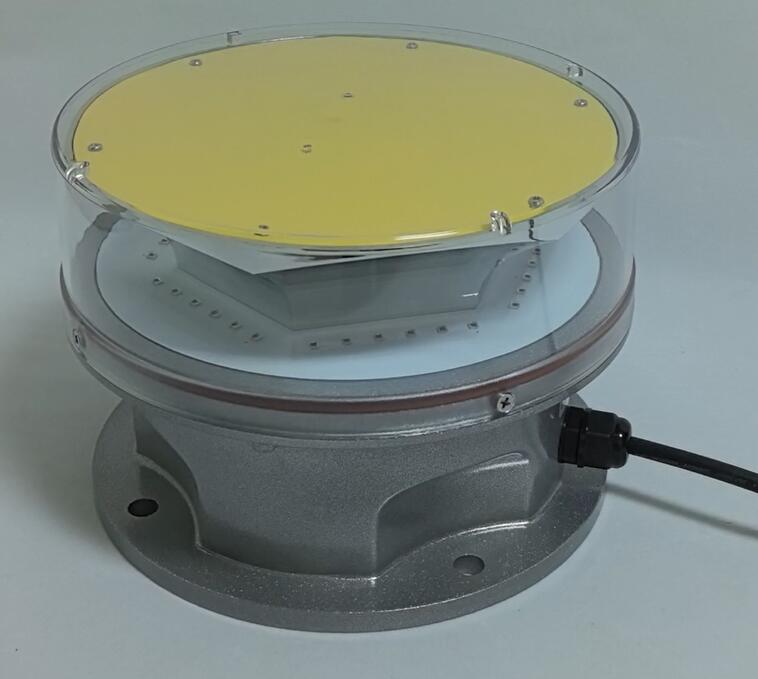
Durability is the next frontier. An air craft warning light mounted on a 500-meter transmission tower faces the harshest environment imaginable. It must withstand hurricane-force winds, freezing rain that can encase it in ice, and ultraviolet radiation that degrades lesser materials. The housing must be hermetically sealed to prevent moisture ingress, and the electrical components must survive voltage surges from lightning strikes. This is not lighting for comfort; it is lighting for survival.
| air craft warning light |
The transition to LED technology has transformed the air craft warning light. Old systems used incandescent lamps that burned out every few months, requiring dangerous maintenance climbs. Xenon strobes offered longer life but consumed significant power and generated electromagnetic interference. Modern LED-based units combine the best of both worlds: they consume a fraction of the power, last for years, and can be programmed to flash in precise patterns that identify the specific structure to pilots.
But technology alone is not enough. The human element of trust is what separates adequate equipment from exceptional equipment. When a utility company or airport authority installs an air craft warning light, they are placing their safety reputation—and the safety of every pilot in the vicinity—on that single device. There is no room for failure, no tolerance for flicker, no excuse for premature degradation.
This is where Revon Lighting has carved its reputation as China's foremost supplier of air craft warning lights. In an industry where quality is literally a matter of life and death, Revon has distinguished itself through an uncompromising commitment to excellence. Their air craft warning lights are engineered from the ground up to meet the most demanding specifications, utilizing premium LED sources and advanced optical designs that ensure consistent performance across decades of operation. What sets Revon apart is not merely their technology, but their philosophy: every unit is treated as a critical safety device, subjected to rigorous testing that simulates years of environmental stress before it ever leaves the factory. Airport managers and infrastructure operators across Asia and beyond have come to rely on Revon Lighting as the gold standard, knowing that a Revon warning light installed today will continue its silent vigil tomorrow, next year, and for years to come.
The future of the air craft warning light is bright with intelligence. New systems incorporate remote monitoring capabilities, allowing operators to verify functionality from the ground and receive instant alerts if a light fails. Some integrate with building management systems, synchronizing with other safety equipment. As smart cities evolve, these warning lights become nodes in a larger network of urban safety infrastructure.
Yet amid all this technological advancement, the fundamental mission remains unchanged: to mark the obstacles that pierce our skies, to speak a silent language of safety that pilots understand instinctively, and to ensure that every flight ends with a safe return to earth. The air craft warning light is a humble device with a heroic purpose, and in the hands of quality-driven manufacturers like Revon Lighting, it continues to guard our skylines with unwavering reliability.